/John Hayden
The Gap Nobody Talks About: Connecting Your Field Team to the Office
Mark's utility management was finally running the way it should. But a phone call from a frustrated resident was about to reveal a gap no billing platform could solve on its own.
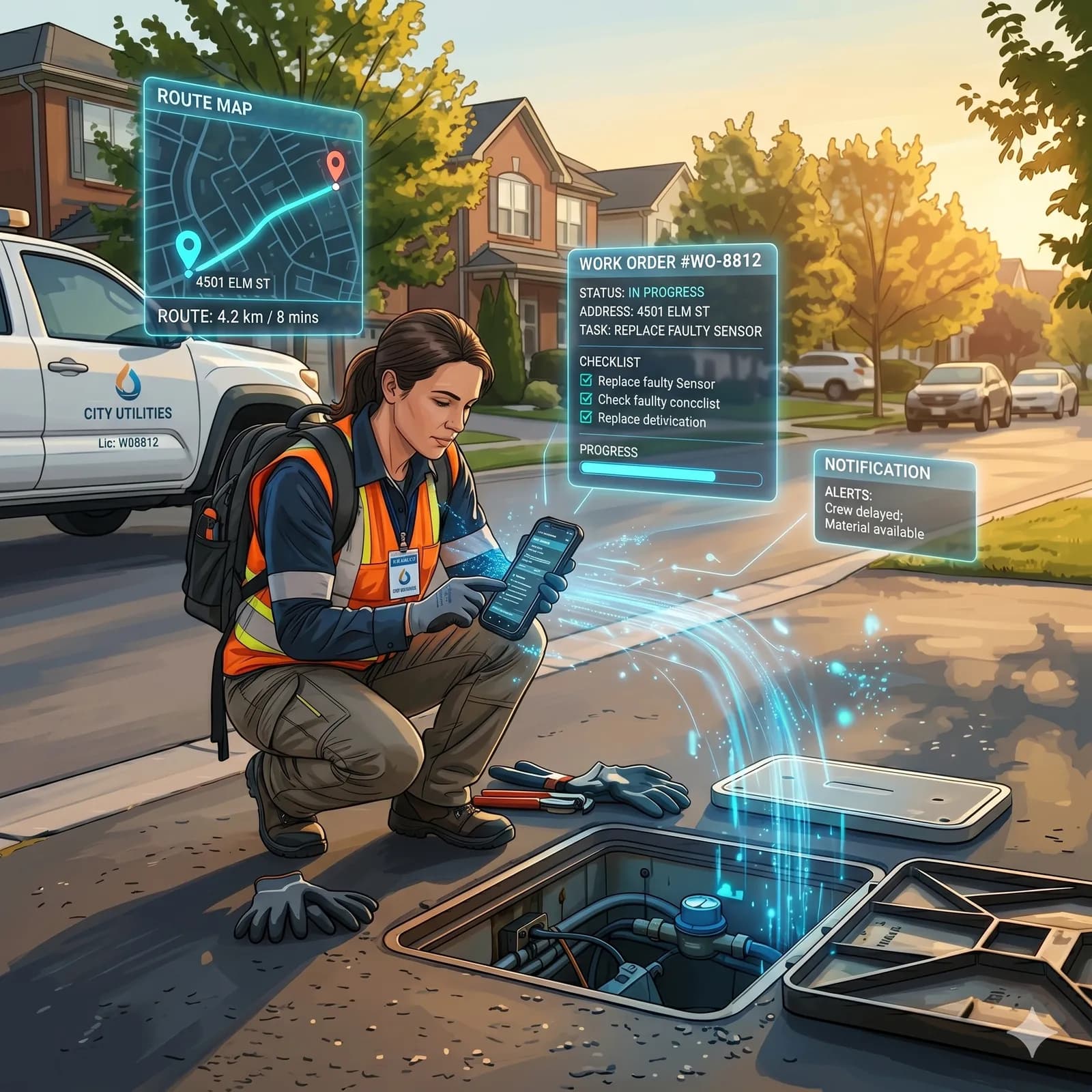
Mark's city had come a long way. His utility management was running on a single platform, meter reads were flowing in automatically, and his team had the real-time data they needed to get ahead of problems before residents noticed them. After months of work, his mornings looked nothing like they used to.
Then Mrs. Patterson called.
She lived at 412 Elm, and her latest bill didn't make sense. Her water usage had spiked, and she was certain something was wrong. Mark pulled up her account. Her reads looked normal. Her billing history was clean. Nothing stood out.
He called his field supervisor.
The supervisor called the tech who had been working that neighborhood.
The tech thought — thought — he might have replaced a meter on Elm Street a few weeks back. Maybe the third house from the corner. He wasn't sure of the exact address. He had noted it in his paper log but hadn't transferred it to anyone.
It took Mark three calls, two emails, and four days to piece together what had happened. A meter had been swapped. The new meter was reading correctly, but nobody had updated the system. The billing cycle had run on the old baseline. Mrs. Patterson's bill was technically accurate — for a meter she didn't know had been changed.
Problem solved. But it shouldn't have taken four days.
The Office Runs the Data. The Field Runs the Infrastructure. Nobody Runs the Connection.
This is the gap that doesn't show up on any report. Mark could track every dollar and every read flowing through Valiflo. But the moment a tech drove away from a job site, that work became invisible to the office until someone picked up a phone and passed the information along manually.
Most cities operate this way. Field crews work from paper logs, text messages, and memory. Office staff piece together what happened after the fact. The gap between those two worlds doesn't feel like a system problem — it just feels like the way things work.
But it is a system problem. And it costs real time, real money, and real trust with the residents you're there to serve.
The hidden costs compound quickly:
- Delayed Updates When field work isn't recorded in real time, billing cycles run on stale data. Discrepancies pile up, and residents receive confusing bills that take hours to untangle.
- Lost Inventory Parts pulled from a truck for a repair live in someone's memory until they make it back to a log. By end of month, nobody can reconcile what was used, where, or for which job.
- Reactive Instead of Proactive Without visibility into what's happening in the field, office staff can only respond to problems after residents call. The proactive posture that interval reads made possible disappears the moment a tech steps out the door.
What a Connected Workflow Actually Looks Like
Mark started thinking about what should have happened with Mrs. Patterson's meter.
The tech arrives at the job. He opens his workflow on his phone — the work order is already there, assigned and routed to his truck. He replaces the meter, scans the new serial number, and logs the parts he used from his inventory. He closes the work order from the field.
Back at the office, the new meter registers automatically. Inventory updates. The platform picks up the new read baseline before the next billing cycle runs. When Mrs. Patterson's next bill generates, it's right — and if anything unusual appears, the system flags it before it ever reaches her doorstep.
Mark doesn't get a call. Mrs. Patterson doesn't get a confusing bill. The tech doesn't have to remember what he did three weeks ago at the third house from the corner.
That's not a technology miracle. That's a connected workflow.
The Field Is Part of the Workflow
Every service call, every meter swap, every repair is a workflow event. Each one generates data the billing office needs, that inventory management depends on, and that residents eventually see reflected in their bills.
Connecting the field to the office isn't about giving crews more technology to manage. It's about making the work they already do visible to the people who depend on it — and giving them simple tools that make that connection automatic.
Mark's operation now runs on connected workflows. His field crews close work orders from the field. His office sees the work as it happens. His utility management runs clean because the data flowing into it is complete from the moment a job is done — not four days later after three phone calls.
His phone doesn't ring as often. And when it does, it's rarely about a meter nobody told the office about.
The gap between field and office is real. For most cities it's simply accepted — the invisible tax on every service call that happens beyond the office door. But it doesn't have to be. When the field and the office run on the same workflow, everything downstream gets better: billing gets cleaner, inventory stays accurate, and utility managers like Mark get their mornings back.
Next, Mark would take a closer look at how connected field operations open the door to something even bigger — building a complete picture of every asset in the city, from the meter at the curb to the pipe in the ground. Stay tuned.